Douglas inspires

Often the delete key is my friend. A thou­sand word post has dis­ap­peared. I was going to post a response to someone else’s post, and use this video of Douglas Adams as an example of pos­it­ive athe­ism. I’m tired of yet another post from someone who says “I’m an athe­ist, but you mustn’t talk about athe­ism or offend the reli­gious because athe­ists are nasty.”

Then I thought if that’s the case why bother? The people who tend to write such posts don’t have any­thing inter­est­ing or pos­it­ive to say apart from scowl­ing at other people who do. Reli­gious people can pro­duce great works, like Handel’s Mes­siah which has a reli­gious mes­sage in it some­where. Then you get books like Dawkins’ Unweav­ing the Rain­bow, that show the sense of won­der you can have in the work­ings of the uni­verse. Yet I can­not think of any­thing remotely inspir­a­tional writ­ten in the heart­felt belief that com­prom­ise is by its nature the goal. No one looks at a beau­ti­ful land­scape, sighs, and says, “It’d be so much bet­ter if there was a small indus­trial estate in the way. Y’know to bal­ance the envir­on­mental and eco­nomic needs of society.”

So instead I’ll just put up the video that TED made pick of the week. If you’re intent on some Sunday athe­ism it’s around 1h 10m in, I think. It’s only a short bit about God. That’s fair enough because it’s a big uni­verse with lots fas­cin­at­ing stuff in it includ­ing his Last Chance to See project.

Red Letter Day: Danish Alphologists Discover the 27th Letter of the Alphabet

DENMARK: Alpho­lo­gists at the Uni­ver­sity of Bil­lund, Den­mark have announced the dis­cov­ery of the 27th let­ter of the Eng­lish Alpha­bet. The let­ter, which has yet to be named, was uncovered dur­ing lib­rary renov­a­tions over the Easter Break. Pro­fessor Olaf Proil who iden­ti­fied the let­ter said the dis­cov­ery was a com­plete sur­prise:

Alpho­lo­gists think there are plenty of let­ters wait­ing to be dis­covered, but that most of these lie out in the far reaches of the alpha­bet, far bey­ond the punc­tu­ation marks and the sym­bols you get on cell­phones. What is so sur­pris­ing is that this let­ter is near the middle of the alpha­bet, between Q and R. It is an extremely small let­ter, which may explain why no-one had noticed it before. We think it may have been hid­den behind the tail, or pesce which comes out of the Q.”


The site of the pro­posed miss­ing let­ter.
© Olaf Proil, Pål Foilor, Uni­ver­sity of Billund

The find is set to be con­tro­ver­sial when it is presen­ted at the Inter­na­tional Alpho­lo­gical Union next month. One pro­fessor has already dis­missed the new let­ter.

We get this kind of head­line every few years and each time it’s proven to be non­sense. It’s almost cer­tainly a vari­ant of another let­ter, just like there are two vari­ants of writ­ing a lower-case A. This was settled a couple of years ago when the IAU elec­ted to des­ig­nate such things as dwarf letters.”

His­tory will prove me right

Proil nev­er­the­less claims there is his­tor­ical proof this is indeed a miss­ing let­ter.

There’s clear evid­ence that this let­ter dates back to the Dark Ages. A close exam­in­a­tion of A His­tory of Eng­land by the Ven­er­able Bede shows there are ele­ments miss­ing from the page. Pre­vi­ously his­tor­i­ans have argued these were spaces, or pos­sibly that he’d for­got­ten to dip his quill in the ink. Doc­u­mented Vik­ing raids on Lindis­farne, the mon­as­tery where the Vul­ner­able Bede wrote his his­tory, could well have taken the let­ter back to Den­mark as booty along with the gold and jewels.”

Proil spec­u­lates that the let­ter could be even older:

We have ref­er­ences to Celtic texts in Roman his­tor­ies, but so far all Celtic mater­ial seems to use the Roman Alpha­bet which was imposed on them when the emperor Max­imus invaded their ter­rit­ory. It is pos­sible some Celtic let­ters were smuggled to Bri­tain dur­ing the Roman inva­sion and hid­den from the con­quer­ors. We need to carbon-date it, but we may have the first pre­his­toric letter.”

Media Con­tro­versy

Dr. Pål Foilor who has assisted Prof. Proil in his work admits that there have been prob­lems in announ­cing the let­ter to the pub­lic.

My first reac­tion was email all my friends with the excit­ing news. That’s when I real­ised I couldn’t, because the let­ter wasn’t on my keyboard!”

Foilor has been work­ing with Com­paq to pro­duce a down­load­able ver­sion of the let­ter which users will be able to type by press­ing Q and R similtan­eously.

“Com­paq are the obvi­ous choice for any com­put­ing work requir­ing heavy-duty lex­ico­graphy. They’ve been safely using a ‘q’ without a ‘u’ buf­fer on their products for years. The sav­ing by using Com­paq makes it 14% more eco-friendly than Com­paqu. That’s the kind of expert­ise we need in repro­du­cing the new letter.”

Rude WordsNot every­one has been so pos­it­ive. Major cell­phone man­u­fac­tur­ers are skep­tical about the new letter’s use. Avril Pois­son of the Amer­ican Cell­phone Fed­er­a­tion said:

While new let­ters might seem like fun, we shouldn’t for­get there’s a cost too. The num­ber 7 on cell­phones already hosts P,Q, R and S. Adding a new let­ter between Q and R could over­load the key and mean we lose the use of 7, which is the world’s luck­i­est number.”

Fam­ily groups have also urged cau­tion, not­ing that the new let­ter might be used to pro­mote drugs, por­no­graphy and women’s rights. Bill Dono­hue, of the Cath­olic League, is said to be angry — though exper­i­enced Donaho­lo­gists are as yet uncer­tain if this is about the letter.

Non­ethe­less Prof Proil says that he is look­ing for­ward to the unveil­ing of the let­ter at noon. “While the let­ter is tiny, the pos­sib­il­it­ies are huge, I think its small size could make it par­tic­u­larly use­ful when describ­ing sub-atomic particles.”

The Dis­cov­ery Chan­nel will be cov­er­ing the event live in their pro­gram “The Lost Letter”.

Other pro­grams cov­er­ing the let­ter in the fol­low­ing week will be a BBC Hori­zon Spe­cial and the His­tory Channel’s “The Secret Let­ter of the Third Reich.”

[Com­piled from a press release by the Uni­ver­sity of Bil­lund and stor­ies around the web]

A chilling example of the dangers of theorising in the Pub

I’ve been reminded that I should link to this paper from Spring 2006 today. I’ve no idea what this author had been drink­ing, but it must have been pretty tasty, because the author clearly drunk a lot of it. Neander­thals explained with the aid of Tom Cruise.

Some people are simply bey­ond help. ;)

Don’t tweak the geeks

Clark­son pub­lished details of his Barclays account in the Sun news­pa­per, includ­ing his account num­ber and sort code. He even told people how to find out his address.

All you’ll be able to do with them is put money into my account. Not take it out. Hon­estly, I’ve never known such a palaver about noth­ing,” he told readers.

Scroll down the page…

I opened my bank state­ment this morn­ing to find out that someone has set up a dir­ect debit which auto­mat­ic­ally takes £500 from my account,” he said.

The bank can­not find out who did this because of the Data Pro­tec­tion Act and they can­not stop it from hap­pen­ing again.

Read the whole thing at BBC News.

Mo’ loot, mo’ troubles

Archae­o­porn has an entry illus­trat­ing one of the prob­lems with buy­ing illi­cit antiquit­ies. It turns out that not all crim­in­als are trust­worthy people. Take for instance the Seal of Yzbl, it’s a seal of Queen Jezebel as men­tioned in the Bible™. At least it is if you don’t look at it too closely. If you do, then all sorts of oddit­ies appear — that’s not a prob­lem it was found at… umm… oh dear.

Archae­o­porn also men­tions the Guen­nol Lion, which I haven’t because I know noth­ing about it. David Gill in con­trast knows as much about its find spot as any­one else.

David Gill has also talked about the Bolton Prin­cess recently. If you don’t know this story, Bolton Coun­cil had the oppor­tun­ity to buy a statue of the Amarna Prin­cess, a 3000+ year old statue from Egypt. There was no check on the proven­ance and the sellers wish to remain anonym­ous. This is par for the course in antiquit­ies sales so far. Noth­ing more would have been heard were it not for the fact that the same sellers tried to sell some wall reliefs to the Brit­ish Museum and some spelling mis­takes were spot­ted. An invest­ig­a­tion fol­lowed and a search revealed three more Amarna Prin­cesses which had been knocked up over a few weeks by a bloke in a shed.

It’s pos­sible the Bolton Armana Prin­cess is a fake.

David Gill has a sens­ible and grown-up reac­tion to the news. Me, I’m reminded of the K Found­a­tion and want to applaud. The case sug­gests that the sting was about art rather than money. The per­pet­rat­ors were described as liv­ing in “abject poverty.” If there were a scheme to ensure the proven­ance of arte­facts for sale then maybe this wouldn’t hap­pen. I’m sur­prised that reput­able col­lect­ors and auc­tion houses aren’t clam­our­ing for such a scheme.

— and an update before this post goes live —

I write quite a few posts in advance, and this is one of them, so I can include another Green­halgh for­gery thanks to the Cranky Pro­fessor. The Art Insti­tute of Chicago has a Green­halgh Gaugin. These things could become col­lect­ible. If you can fake proven­ances, then how many unproven­anced antiquit­ies on dis­play are fake?

Friday Cat Bloggin

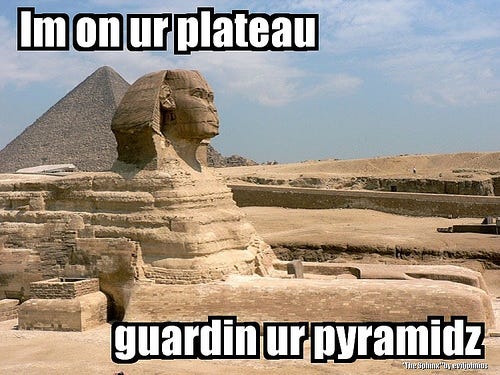
Lolcat?
Ori­ginal photo by Evil­johnius.

I’ll be hon­est I don’t under­stand Lolcats, but I thought I’d try and get into the spirit of the thing. You’ve prob­ably seen sim­ilar around the web, sorry teh web, and now you can make your own, sorry sorry, ur own with a tool from Big Huge Labs.

At a time when much writ­ing was (a) pictorial and (b) carved in stone, it could be argued that the ancient Egyp­tians were the ori­ginal cat bloggers.

Creationism comes to Flickr

After a request by Pappa Cam­bria, there’s now a Cre­ation­ism group on Flickr.

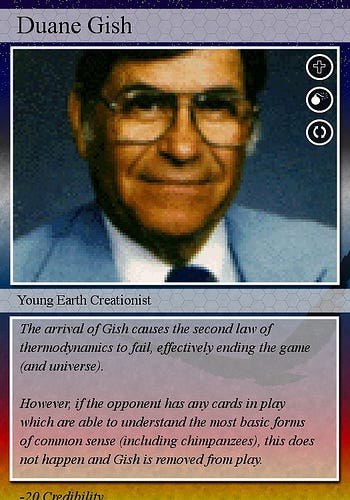
Duane Gish
Duane Gish card cre­ated by Pappa Cam­bria.

Mem­ber­ship is open to every­one, so you can add your own cards. Some­time before next Dar­win Day I plan to write up the rules for Cre­ation­ism: The Card Game (or Cre­ation­ismTCG if I get car­ried away). I’ve got a fairly well fleshed-out idea of how it would work, and it won’t be a Magic rip-off. There’s a nod to Net­run­ner though.

Briefly the game will be Cre­ation­ist versus Sci­ent­ist. The Scientist’s goal will be to gain 30 cred­ib­il­ity points, which ends the game. The Creationist’s aim will be to gain as many cred­ib­il­ity points as pos­sible before the Sci­ent­ist wins.

The full match will be two games, with the play­ers play­ing once as Sci­ent­ist and once as Cre­ation­ist with the win­ner being the player with the highest aggreg­ate cred­ib­il­ity. The Sci­ent­ist player will gain points by pub­lish­ing papers and books. The Cre­ation­ist player will gain cred­ib­il­ity by get­ting reli­gion into schools or inter­fer­ing with the Scientist’s cards.

Now THAT’S a review

Stinky
Photo (cc) Ana­log Pho­tos.

Phil sent me a link to the Amazon UK page for the new book by Richard Little­john. He’s a hack for the Daily Mail, a news organ­isa­tion that makes Fox News look fair and bal­anced, so I thought that Phil’s recent trip to Syria had left him with men­tal trauma. Not so. You’d expect the book to pick up mixed reviews. On the con­trary it’s pick­ing up wide acclaim, and masses of five star votes. Here’s a sample of the 5/5 reviews:

No-one else can express such com­plex right wing views in such a mono­syl­labic form.
To buy only one copy of this book would be a crime.

With this insight­ful, vis­ion­ary, and — I am not ashamed to say — celes­ti­ally inspir­a­tional com­ment­ary on mod­ern life, Richard Little­john has rendered the entire canon of West­ern lit­er­at­ure, philo­sophy and eth­ical dis­course entirely moot.

Littlejohn’s book is so bril­liant that when, as is inev­it­able in mod­ern Bri­tain, a gay immig­rant made an attempt to steal it from my bag it lit­er­ally burnt his hands and made them dis­solve a little bit.

There are those who credit Plato with defin­ing that obscure and fluc­tu­at­ing arte­fact which has been termed the ‘west­ern mind’. Per­haps we might admit the philo­sophies of Jesus of Galillee and Freid­rich Niet­zche into that élite club of thinkers who have con­trib­uted to its fur­ther elu­cid­a­tion — but never before has a work emerged of which we can tri­umphantly declaim: Plato is obscured, we have our new republic!

I recently died and went to heaven. This book bought me back.

Little­john steam­roles through everything wrong with our coun­try– keep­ing people safe, re-using rub­bish, etc.- in a bril­liant style that evokes Dick­ens at his best.

Fur­ther­more, I have read Tol­stoy, and yes, this does indeed turn into Tol­stoy– i for­get where exactly, but some­where between pages 204 and 206.

Hav­ing cre­ated a new paradigm in non-fiction lit­er­at­ure, as awe­some in its sweep as it is remark­able in its vis­ion, the only ques­tion that remains is where will Little­john go from here?

If you like Little­Johns opin­ions I urge you to get some­body to read it out aloud for you, priceless!

If you only buy one ill-focussed, obvi­ous, point­less rant at the expense of easy tar­gets who would prob­ably need to board up their win­dows if any of the people who sup­port Little­john could actu­ally read, then make it this one.

The reviews are amaz­ing, and there’s over sev­enty of them.

Another petition

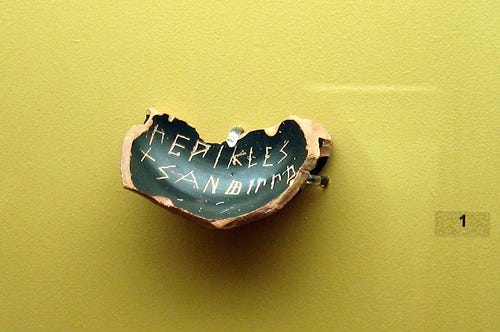
Perikles Ostracon
A vote to ostra­cise Pericles. Photo (CC) Wal­lyg.

Occa­sion­ally there is a peti­tion which does seem like a stroke of genius. This is an example.

We the under­signed peti­tion the Prime Min­is­ter to cre­ate the pro­ced­ure of ostra­cism as prac­tised under the ancient Greek Athenian democracy.

Now I know what you’re think­ing. Ostra­cism was a pecu­li­arly Athenian idea. It’s all very well sug­gest­ing we have a vote and exile the most (un?)popular choice from the UK for ten years, but times have changed. Surely it couldn’t work in prac­tice. Think about the fine detail.

But someone has.

Use any funds gen­er­ated from TV rights for good causes.

Put the Baron of Weston-super-mare up against Tony Blair and you could fund the NHS for a dec­ade from the fees from the phone-in votes.

Then Why Are There Still Humans?

...then why are there still humans?
Ori­ginal image by vj_pdx.

I’m busy today, so I don’t have time to put together the Dar­win Day post that I’d like to. In the mean­time here’s another Cre­ation­ism card. I’m start­ing to get an idea of how a game would work, so tent­at­ively there might be more cards up and a work­ing game for the next Dar­win Day.

One reason I’m slightly rushed is that I spent time catch­ing up on Ori­gins Revis­ited, a Radio 4 series look­ing at the updated evid­ence for Human evol­u­tion. You can listen to all three pro­grammes via the archive.